Most Japanese outdoor hot spring baths look at a garden, a rock, or a mountain. Very few of them look at a city.
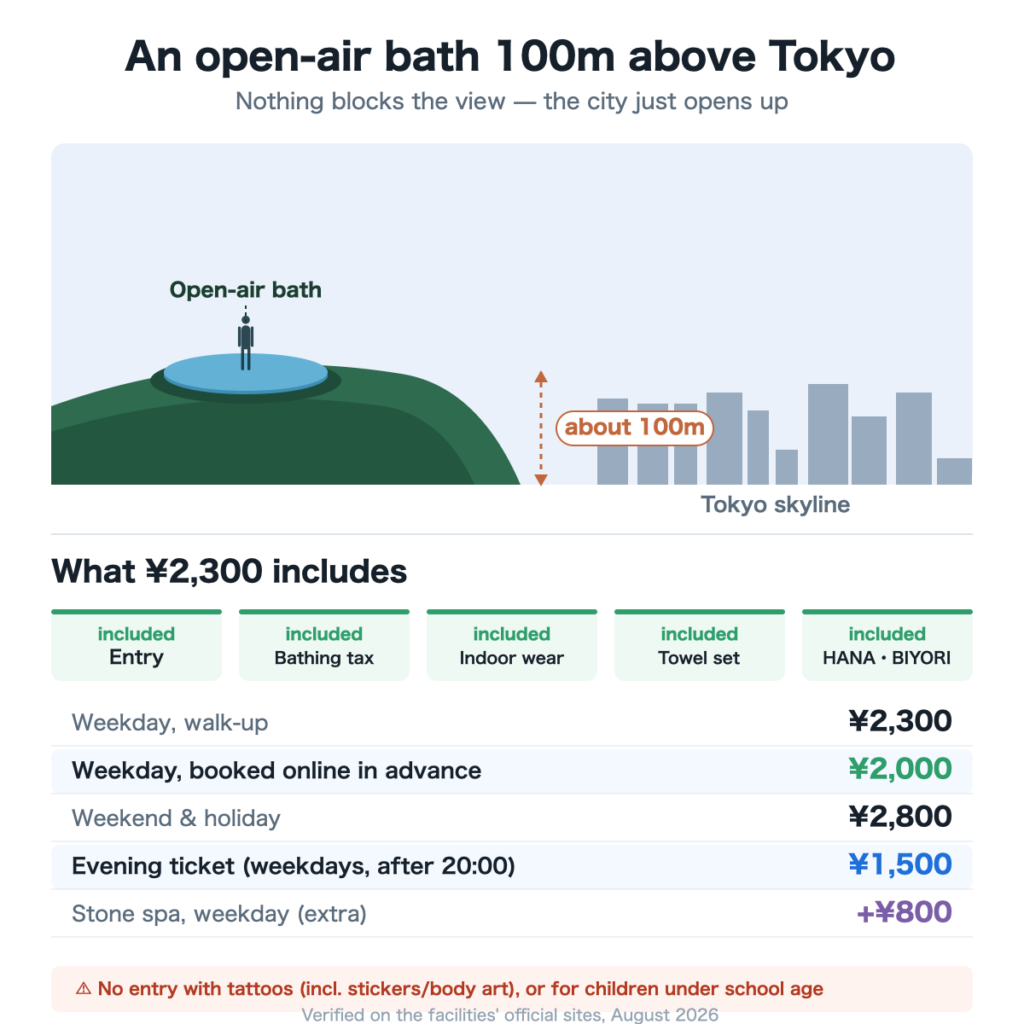
Yomiuriland Chobo Onsen Kakei no Yu (よみうりランド眺望温泉 花景の湯), in Inagi on the western edge of Tokyo, sits on a hill roughly 100 metres above the surrounding land. Its outdoor bath faces the city, and while you’re in the water, the Tokyo skyline is spread out in front of you.
I have visited fourteen day-use hot springs around Tokyo. For the view alone, this is the best one, and it isn’t close.
It is also the most expensive of the ones I use regularly: ¥2,300 on a weekday, roughly three times what I usually pay. This piece is about what that money actually buys.
What you’ll get from this guide
- What the view from the bath is really like
- What the ¥2,300 ticket includes (more than you’d think)
- The sauna, the water, and the stone spa
- Onsen etiquette, tattoos, cash and towels — read before you go
- How to get there and how long it takes
First: is this your first Japanese onsen?
Four rules cover nearly everything.
- You bathe naked. No swimsuits. Baths are separated by gender: 男 = men, 女 = women
- Wash thoroughly before entering the water. Sit at the shower station, wash, rinse, then soak. The bath is not for cleaning
- Keep the small towel out of the water — on your head or the rim
- No photography in the bathing areas, ever. This is why every interior photo you find online is an official one
On tattoos — important: this facility does not admit anyone with a tattoo. The official site is explicit that this includes small ones, stickers and painted body art. If you have a tattoo of any size, you will be turned away at the entrance, so please plan around it. (Policies differ across Japan; some places allow tattoos or provide cover patches, but this one does not.)
On cash: carry some. Cards are usually fine at a facility of this size, but don’t rely on it.
Good news on towels: here, a towel set and indoor wear are included in the entry price. You can turn up empty-handed. That is not the norm in Japan and it matters for the value calculation below.
The basics
| Name | Yomiuriland Chobo Onsen Kakei no Yu (よみうりランド眺望温泉 花景の湯) |
| Location | 4015-1 Yanokuchi, Inagi, Tokyo — inside the HANA・BIYORI flower park |
| Weekday entry | ¥2,300 (about US$15) / ¥2,000 if booked in advance online |
| Weekend & holiday entry | ¥2,800 / ¥2,500 booked online in advance |
| Evening ticket | ¥1,500 for entry after 20:00 on weekdays (not sold in peak periods) |
| Included | Bathing tax, towel set, indoor wear and the HANA・BIYORI garden |
| Stone spa “Higamabo” | ¥800 weekdays / ¥900 weekends — separate charge |
| Not admitted | Anyone with a tattoo (including stickers and body art), and children under school age |
| Elevation | about 100m, on a hillside |
| Water | Weakly alkaline sodium chloride & bicarbonate spring, from 1,750m underground |
| Sauna | Large room seating 30+, auto-löyly every 20 minutes |
| Opened | March 2024 |
| Official site | Kakei no Yu |
Prices are correct as of August 2026; yen converted at roughly ¥150 = US$1. Weekend, holiday and peak-season rates are higher. Check the official price page and opening hours before you go.
The view
The building sits partway up a hill, and the outdoor bath is placed to face outward with nothing in the way. You lower yourself into hot spring water and the city is simply there, below you, going on into the distance.
Written down it sounds like any “bath with a nice view”. In practice the difference is the scale of it. Japanese outdoor baths are usually designed to make you look at something small and composed — a maple tree, a rock, a fence of bamboo. This one asks you to look at a whole city.
Among the fourteen day-use baths I’ve been to around Tokyo, nothing else comes close on this single measure.
I have only been during the day. Daytime is already worth the trip. Night views are presumably spectacular, but I haven’t experienced that myself, so I’m not going to describe it as if I had.
The water and the sauna
The view gets the attention, but the bathing itself holds up.
The outdoor bath uses a genuine hot spring drawn from 1,750 metres underground — a weakly alkaline sodium chloride and bicarbonate spring. Indoors there are:
- High-concentration carbonated bath
- Silk bath (with an electric bath alongside)
- Jet baths and relaxation baths
The sauna is serious: a large room seating more than 30 people, with automatic löyly every 20 minutes (details).
And here is the detail that ties the whole place together: the outdoor area has a large number of reclining chairs for cooling down. So the sauna → cold water → open-air rest cycle happens with the city in front of you. That combination genuinely doesn’t exist anywhere else I know of near Tokyo.
The facility also runs Aufguss sessions on selected dates — a sauna master waving hot air onto you with a towel. If that appeals, check the event schedule before choosing your day.
Staying a while
The paid stone spa “Higamabo” (¥800 on weekdays) gives you provided clothing and a set of heated stone rooms, saunas and cool-down spaces.
The wider site includes a Japanese garden, an observation deck, a terrace, and free rest areas. This is not a place designed for a quick dip — it is designed for you to stay, which is exactly how you should approach the price.
Is ¥2,300 too much?
Let me be straight: it is not cheap. Here is where it sits among day-use baths around Tokyo (weekday adult rates, August 2026).
| Facility | Weekday entry |
|---|---|
| Tokyo public bathhouse (regulated price) | ¥600 |
| Sengawa Yukemuri no Sato (Chofu) | ¥920 |
| King & Queen (Tokorozawa) | ¥950 |
| Jindaiji Onsen Yumori no Sato (Chofu) | ¥1,080 |
| Takaosan Onsen Gokurakuyu | ¥1,100 |
| Nagomi no Yu (Ogikubo) | ¥2,300 |
| Kakei no Yu | ¥2,300 |
| Thermae-Yu (Shinjuku) | ¥3,100 |
Facility names are links. Where I’ve written a full guide, they go to that article; otherwise they go to the facility’s official site (most are Japanese-only).
The bath I use most often costs ¥920. This is about two and a half times that.
But two things change the arithmetic. First, the towel set and indoor wear are included — at most Japanese facilities those are extra, and if you’re travelling, arriving empty-handed is worth real money and hassle avoided. Second, booking online in advance drops the weekday price to ¥2,000.
My honest conclusion:
If you go planning to stay for most of a day, ¥2,300 is fair. If you go for a quick soak, it will feel expensive.
Arrive in the morning, bathe, look at the view, sweat in the stone spa, eat, bathe again, leave in the evening. Done that way, it’s good value. And the view was the best I have experienced in any bath, anywhere — that is what you are paying for, and I think it’s worth paying.
Getting there
The facility is inside the HANA・BIYORI flower park, next to the Yomiuriland amusement park, at 4015-1 Yanokuchi, Inagi, Tokyo.
From Shinjuku, the Keio Line runs west toward Keio-Yomiuriland Station; the trip out from central Tokyo takes roughly 30–40 minutes depending on the service, and there is a gondola and a bus connection for the final stretch up the hill.
Check the official access page for the current route options and the gondola timetable before you go — the last connection up the hill matters if you’re planning a long stay.
You can pay for trains with Suica, PASMO or any compatible IC card.
Who it’s for
Go if:
- You want a genuinely spectacular view from a hot spring without leaving Tokyo
- You have a full day and want to spend it slowly
- You’re travelling light — towels and indoor wear are included
- You want the sauna → cool down → open-air rest cycle with a skyline in front of you
Skip if:
- You’re looking for a cheap local bath experience — a neighbourhood sento at ¥600 is a truer version of that
- You only have an hour — you won’t get your money’s worth
- You have tattoos and can’t confirm the policy in advance
Summary
- Sits about 100m up a hillside, with an outdoor hot spring bath facing the Tokyo skyline
- The best view from a bath I have ever experienced
- Real hot spring water from 1,750m underground, plus carbonated and silk baths
- 30+ seat sauna with auto-löyly every 20 minutes, and plenty of outdoor reclining chairs
- ¥2,300 on a weekday, or ¥2,000 booked online — towel set and indoor wear included
- Best value if you stay most of the day
If you choose your baths by price or convenience, this isn’t your place. But if you have one day in Tokyo you want to spend differently — sitting in hot water, looking at the city you’re visiting — it’s worth the fare and the climb.
Official links
| Official site | Kakei no Yu |
| Prices (incl. advance tickets) | Charge |
| Opening hours | Information |
| First-time guide | How to use |
| Baths, sauna & rest areas | Ofuro & Sauna |
| Stone spa | Ganbanyoku |
| Water analysis (PDF) | Spring quality |
| Getting there | Access |
| English page | Kakei no Yu (EN) |
Official Instagram: @kakeinoyu — the best place to see the view before you commit to the trip.
Related
- The only water bath in Japan you’re allowed to dive into — King & Queen
- Tokyo day-trip onsen guide — 14 baths, ranked (to be written)