In almost every bathhouse in Japan, the cold bath comes with the same instructions: don’t run, don’t dive, don’t submerge your head.
Then there is Onsen Balcony King & Queen in Tokorozawa, Saitama, whose official website describes its cold bath like this:
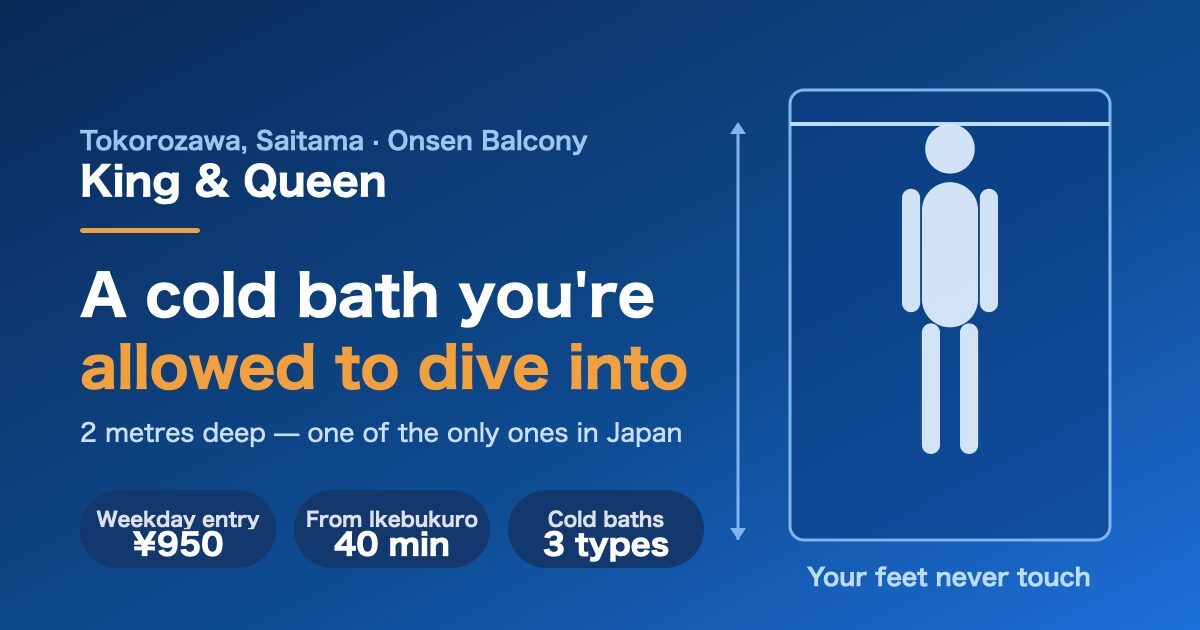
You can dive. You can swim. You can jump in.
It is two metres deep. And I did jump in.
That sentence is the reason this place is worth a detour. Getting out of a properly hot sauna and dropping into two metres of cold water — your whole body under, not just up to your shoulders — is something you cannot do at a normal Japanese bathhouse, because a normal Japanese bathhouse would stop you.
The other reason is more practical: it’s about 40 minutes from Ikebukuro, and you don’t need a car.
What you’ll get from this guide
- What a 2-metre cold bath is actually like
- A cold room at -20°C with a cold bath inside it
- Weekday entry: ¥950 — and what that buys you
- How to get there by train + free shuttle bus (this is where most guides fail you)
- Onsen and sauna etiquette if this is your first Japanese bathhouse
- Honest notes on tattoos, cash and towels before you go
First: is this your first Japanese bathhouse?
If so, read this section. The rules are simple, but breaking them is genuinely awkward.
- You bathe naked. No swimsuits. Baths are separated by gender: 男 = men, 女 = women. Your locker key is usually a wristband
- Wash before you get in. Sit on a stool at the shower station, wash and rinse completely, then enter the water. The bath is for soaking, never for cleaning
- Keep the small towel out of the water. Fold it on your head or leave it on the edge
- No photography anywhere in the bathing areas. This is absolute. All the photos you see online of the interior are official ones
- In the sauna, sit on a towel or mat and keep your voice down
On tattoos — important: this facility does not admit anyone with a tattoo, and the official site states that this includes stickers. If you have a tattoo of any size, you will be turned away at the entrance — and this is a long trip to make for nothing. (Policies differ across Japan; some places allow tattoos or provide cover patches, but this one does not.)
On payment: carry some cash. Larger facilities usually take cards, but it is never guaranteed, and vending machines inside often want coins.
On towels: check whether towels and loungewear are included in your ticket or rented separately. At many Japanese day-use baths they are extra.
The basics
| Name | Onsen Balcony King & Queen (温泉バルコニー キング&クイーン) |
| Location | Kitanaka 2-271, Tokorozawa, Saitama |
| Hours | Mon–Thu 9:00–01:00 / Fri & pre-holiday 9:00–02:00 / Sat 6:00–02:00, Sun 6:00–01:00 (6:00–8:00 is morning-bath service) |
| Weekday entry | ¥950 (roughly US$6) |
| Weekend / holiday entry | ¥1,100 |
| Stone spa (ganbanyoku) | ¥1,000 weekdays / ¥1,200 weekends — separate charge |
| Rooftop “Sky High” zone | ¥700 / ¥800 — separate charge |
| Hot spring | Natural, drawn from 1,300m underground |
| Water | Sodium-calcium chloride cold mineral spring, pH 8.6 |
| Baths | 6 types |
| Saunas | 3 types (plus 2 more in the rooftop zone) |
| Cold baths | 3 types — one of them 2m deep |
| Opened | September 2024 |
| Official site | King & Queen |
Prices are correct as of August 2026. Yen amounts converted at roughly ¥150 = US$1 — check the current rate. Always confirm on the official pricing page before you go.
The 2-metre cold bath
There are three cold baths here, which is unusual in itself.
The 2m natural hot spring cold bath
The official wording is “You can dive. You can swim. You can jump in.”
Two metres deep means your feet do not touch the bottom. For comparison, a typical Japanese cold bath is 50–70cm deep; the ones people call “deep” are around one metre. This is a different category of thing.
Jumping in, your entire body goes under at once. A normal cold bath cools you from the shoulders down. Here the heat leaves you from every direction simultaneously, including the top of your head. If you have spent any time in Japanese sauna culture, you already know why this is worth travelling for.
Please be careful. Diving is permitted here because the facility built the bath for it. Do not try this anywhere else in Japan. Two metres is genuinely deep — if you are not a confident swimmer, use one of the other two cold baths instead.
The -20°C freezing room
The second one is strange. There is a room chilled to -20°C, with a cold bath inside it whose water sits in the single digits Celsius. The air and the water are both freezing, so there is nowhere to escape to. The facility calls it their “professional grade” bath.
The 23°C mild bath
The third is 23°C — warm, as cold baths go. It cools you down gently and is the sensible choice if extreme cold isn’t your thing.
Having all three means you choose your own intensity. Some days you dive into two metres; some days you sit quietly in 23°C water.
The saunas: a 7-tier stadium
According to the official sauna page there are three saunas:
- Mount Fuji lava löyly sauna — the sauna stones are volcanic rock from Mount Fuji. Seven tiers for men, six for women, one of the largest stadium-style saunas in the Kanto region
- Natural hot spring steam sauna — filled with steam made from the hot spring water itself
- Salt sauna — you rub salt on your skin as you sweat
Seven tiers matters. In a tiered sauna, heat rises, so the top row is significantly hotter than the bottom. You can choose your own difficulty inside a single room — and the top row gets hot enough to justify a two-metre plunge afterwards.
The rooftop terrace, BlueSky THE BALCONY, has a separately-priced zone called Sky High (¥700) containing a barrel sauna, a tent sauna and a -20°C freezer box. Counting those, the site has five saunas in total.
The facility was also selected for SAUNACHELIN 2025, an annual list of “saunas worth visiting right now” chosen by Japanese sauna specialists. So it isn’t only me who rates it.
It is also, simply, a good hot spring
The water is drawn from 1,300 metres underground — a sodium-calcium chloride mineral spring at pH 8.6. There are six baths:
- Natural hot spring
- Hot spring with strong carbonation
- Silk bath — milky white, the colour coming from countless microscopic bubbles
- Carbonated head-massage bath
- Private bath — a generously sized tub built for one person
- Lying-down bath — you lie on your back and warm your whole spine
The private single-person bath is a small kindness you don’t often find. And crucially, some of the baths are lukewarm, which means you can soak for a long time. A lot of sauna facilities only offer scalding water; here you can have a slow bath and skip the sauna entirely if that’s your mood.
The whole building is also extremely clean — it only opened in September 2024.
Staying all day: stone spa, manga and a rooftop
If you want to make a day of it, add the stone spa (ganbanyoku — you lie on a heated stone floor in provided clothing and sweat slowly).
- Several different stone spa rooms
- A large manga library
- A big relaxation space
- A rooftop with sofas, where you can sit outdoors doing absolutely nothing
Sweat, read, bathe again, lie on the roof. Afternoons disappear. There’s a large food court too, so you never need to leave the building.
How to get there without a car
This is the part other guides get wrong.
The facility has 400+ free parking spaces, which makes people assume you need to drive. You don’t. I don’t own a car and I always go by train plus the free shuttle bus.
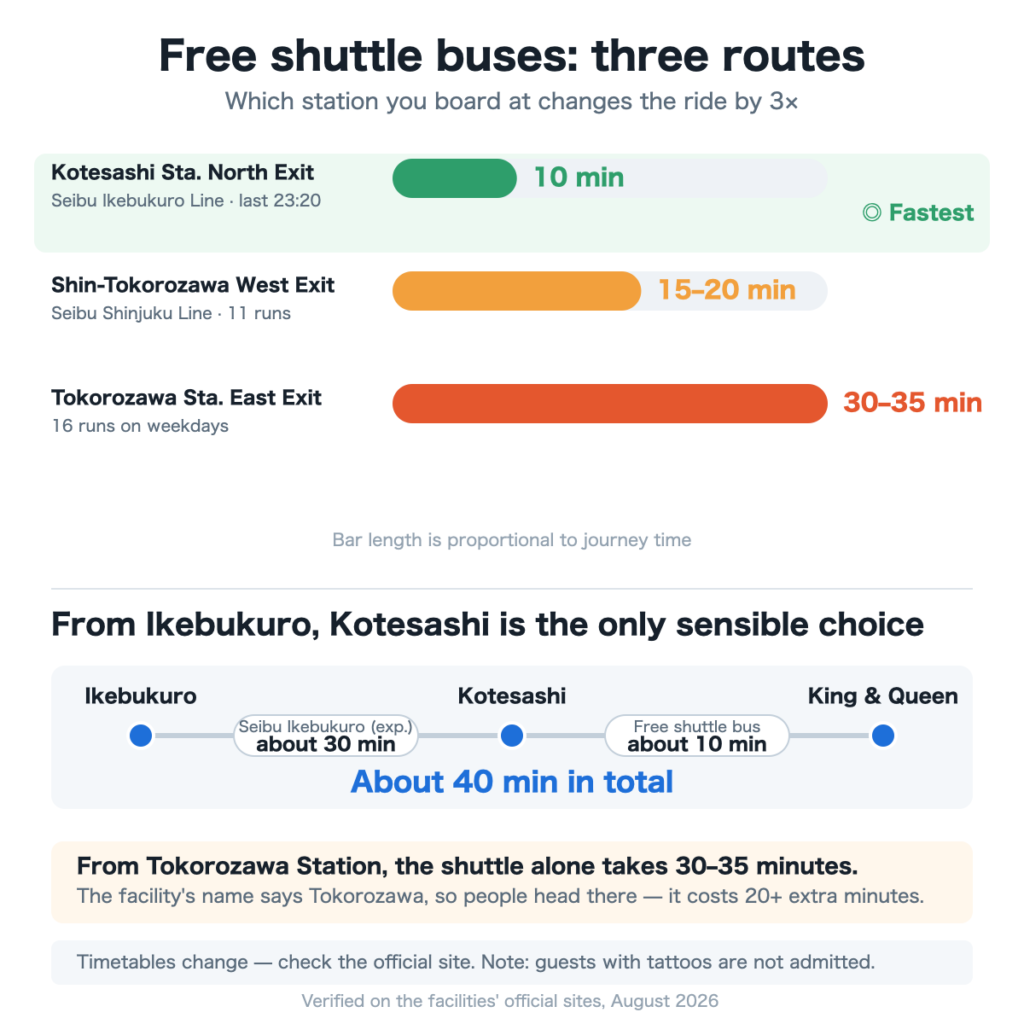
There are three shuttle routes, and the one you choose changes your journey by a factor of three.
| From | Pick-up point | Ride time | Weekday departures |
|---|---|---|---|
| Kotesashi Stn, north exit (Seibu Ikebukuro Line) | under the elevated section by the roundabout | about 10 min | 23/day (08:50–23:20) |
| Shin-Tokorozawa Stn, west exit (Seibu Shinjuku Line) | in front of “Hidamari Pharmacy” | about 15–20 min | 11/day |
| Tokorozawa Stn, east exit | in front of Ashikaga Bank | about 30–35 min | 16/day |
Use Kotesashi, not Tokorozawa
Ikebukuro → (Seibu Ikebukuro Line express, about 30 min) → Kotesashi → (free shuttle, about 10 min) → arrive. Roughly 40 minutes in total.
The trap: the facility is in Tokorozawa, so visitors naturally head for Tokorozawa Station — where the shuttle takes 30 to 35 minutes. Going via Kotesashi saves you more than twenty minutes each way, and it is purely a matter of knowing.
Coming from Shinjuku, you can take the Seibu Shinjuku Line to Shin-Tokorozawa (about 40–45 min) and shuttle from there, but going via Ikebukuro is faster.
You can pay for the trains with a Suica or PASMO IC card, or any of the compatible cards. The shuttle bus is free.
The last weekday shuttle from Kotesashi leaves at 23:20, and on weekends the first one runs at 06:45, so both early starts and late finishes work.
Shuttle timetables change — the Kotesashi route was revised on 29 July 2026. Always check the official shuttle page before you set off.
Is it worth the trip?
Worth going if:
- You are into sauna culture. The 2m cold bath does not exist elsewhere
- You want a full day somewhere cheap. ¥950 for this scale is remarkable value
- You are staying in Ikebukuro or on the Seibu Ikebukuro Line. 40 minutes each way
- You want to see a Japanese bathhouse that locals actually use, rather than a tourist-facing one
Probably skip it if:
- Your Tokyo time is very short. This is a half-day round trip out of the city
- You can’t swim. Use the other two cold baths — and be honest with yourself about the 2m one
- You have tattoos and can’t confirm the policy in advance
Summary
- A 2-metre cold bath the facility openly invites you to dive into — effectively unique in Japan
- A -20°C freezing room with a cold bath inside it
- Seven-tier stadium sauna using Mount Fuji lava stones, selected for SAUNACHELIN 2025
- A genuine natural hot spring with six baths, including lukewarm ones for long soaks
- ¥950 on weekdays (about US$6)
- About 40 minutes from Ikebukuro. No car required — but get off at Kotesashi, not Tokorozawa
Japan has thousands of bathhouses, and most of them will tell you not to jump in the water. This one built a bath for it. If you have a spare afternoon in Tokyo and any curiosity about sauna culture, go and jump in.
Official links
Prices and timetables change. Check before you travel.
| Official site | King & Queen |
| Prices & hours | Guide |
| Shuttle bus timetable | Access |
| Saunas & baths | Sauna & Bath |
| The 2m cold bath | Water Bath |
| Stone spa | Ganbanyoku |
| Food | Food Court |
Official Instagram: @king_and_queen_282828
Related
- An onsen with a view over the Tokyo skyline — Kakei no Yu (EN version, to be published)
- Tokyo day-trip onsen guide — 14 baths, ranked (to be written)